

Animal Hospital’s Simple Loop Hides Surprising Depth

Animal Hospital has quickly become one of Roblox’s biggest new games of the summer.
Released in May*, the cooperative survival-horror game rapidly climbed Roblox’s charts, eventually competing with long-running platform leaders like Brookhaven for the platform’s largest audiences. By July, Animal Hospital had become Roblox’s second most-played game by average concurrent players (according to Rolimons daily CCU data), an impressive rise for a game built around a premise that initially appears surprisingly simple.

Up to four players work the night shift at a hospital for humanoid animals. Patients arrive at reception, players check them in, diagnose their illnesses, and provide the correct treatment. The catch is that some patients are not patients at all. They are anomalies disguised as ordinary animals, and letting the wrong one inside can turn an otherwise routine shift into chaos.
The concept pulls together elements familiar from several recent Roblox hits. Its anomaly-detection loop resembles Scary Shawarma Kiosk, another breakout horror experience that has now surpassed 1.2 billion visits and asks players to identify dangerous customers while completing a routine service job. Its colorful characters and darker horror elements also fit within Roblox’s broader wave of approachable survival-horror games like 99 Nights in the Forest and Dandy’s World.
Animal Hospital takes clear inspiration from Scary Shawarma Kiosk’s anomaly-detection formula, but expands that foundation with a more approachable presentation and a much broader set of systems. Its colorful animal characters soften the horror and make the experience more accessible to younger players, while unpredictable events, playing with friends, recurring characters, and hidden secrets gradually transform a simple patient-management loop into controlled chaos.
A Simple Hospital Job Becomes a Horror Game
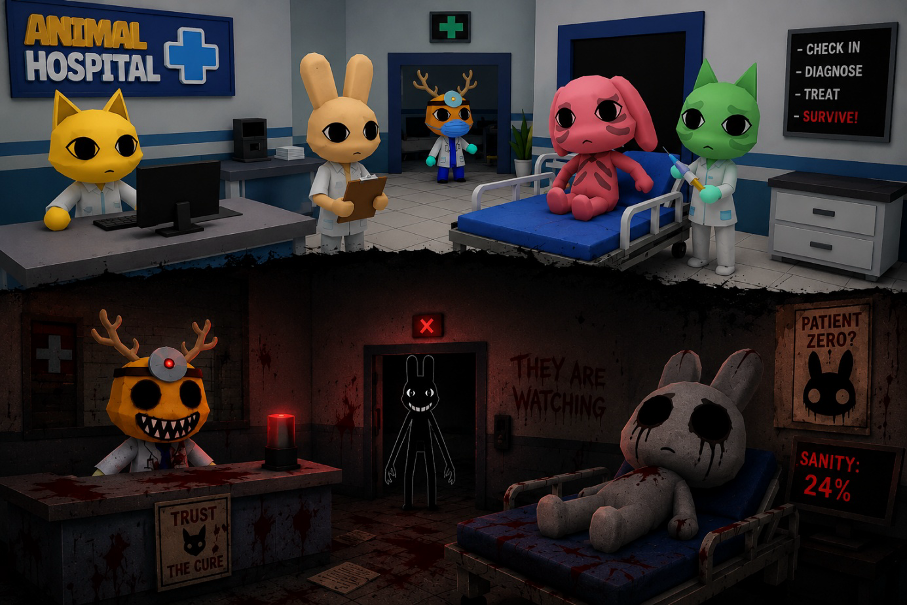
Animal Hospital begins like a straightforward service-management game (a game built around serving customers and completing routine tasks efficiently).
Players process incoming patients at reception, inspect their information, register them in the hospital, and assign them to rooms. Once admitted, patients need to be diagnosed through activities such as DNA analysis, X-rays, heart scans, or surgery before players collect the correct medicine or medical supplies.
This loop is easy to understand:
Patient arrives → Check-in → Diagnose → Treat →Repeat
Animal Hospital then adds a second layer on top of this routine.
Some patients are anomalies attempting to enter the hospital and cause havoc. Players must inspect their appearance, compare photographs, monitor security cameras, and look for inconsistencies that reveal whether the patient is legitimate or something more sinister. The clues are not always obvious, forcing players to compare what they see at reception with photographs and CCTV footage before making a decision.
This turns an otherwise repetitive hospital workflow into a constant observation test. Players are not only trying to treat patients efficiently, but also deciding who they can safely let inside.

Each Shift Adds Another Layer of Controlled Chaos
Individual tasks in Animal Hospital rarely become especially complicated. Instead, the game steadily increases the number of things players need to manage at once. Each new mechanic is relatively straightforward on its own, keeping the barrier to entry low even as the overall experience becomes more demanding.
Early shifts are relatively calm, but later ones introduce more patients, new treatment rooms, emergencies, hostile anomalies, fires, and other interruptions that compete for the player’s attention.
Eventually, treating a patient with dried eyes is no longer simply a matter of grabbing eye drops. The player may need to do that while another patient is critical, someone is waiting at reception, and an anomaly is loose inside the hospital.
This is where Animal Hospital’s difficulty comes from. The game creates controlled chaos by combining simple problems until players have to constantly decide what deserves their attention first.
That pressure can continue across increasingly high shift counts, giving players milestones such as Shift 10, 25, 50, or even 100, and creating a long-run survival structure somewhat reminiscent of 99 Nights in the Forest.
Just as importantly, shifts can unfold differently depending on both the events that appear and the choices players make. Rejecting a suspicious patient, prioritizing one emergency over another, choosing different upgrades, or dividing responsibilities differently with teammates can all change how the hospital operates. That variability keeps the underlying routine from becoming completely predictable and gives players room to experiment with different strategies from one run to the next.

Cute Characters Hide a Much Darker Mystery
Animal Hospital’s presentation also makes its horror unusually approachable. Its colorful environments and stylized animal characters evoke some of the friendliness of Nintendo’s Animal Crossing, a series built around interacting with a community of cute animal residents. That welcoming presentation contrasts sharply with distorted patients, monsters, rituals, and the increasingly dark story surrounding the hospital.
Recurring characters deepen that contrast. NPCs such as Dr. Harlow, Ron, Barney, and Rathu repeatedly return throughout runs. Rather than functioning as one-off quest characters, they gradually provide players with gameplay tips, rewards, secrets, and clues about the hospital’s larger mystery.
Recent updates have continued expanding this discovery layer through additional lore, characters, and secrets. These additions give players another reason to keep returning beyond simply surviving another shift. Reaching a higher shift is one goal, while uncovering something they have not seen before becomes another.
In that sense, Animal Hospital shares something with games like the indie hit Stardew Valley: an approachable core experience that gradually reveals more characters, secrets, and systems the longer players engage with it. The game is more than its initial survival-horror premise, with each new discovery adding another layer beneath the surface.
The Harder Challenge Comes After The Breakout
Animal Hospital has already proven that its concept can attract a massive Roblox audience. The more difficult question is how long it can sustain that attention. Like many Roblox breakouts, that initial surge can fade as novelty wears off and players shift their attention toward newer games.
One of Animal Hospital’s biggest strengths is also a potential weakness.
Its hospital workflow is intentionally repetitive. Players repeatedly check in patients, diagnose illnesses, identify anomalies, and try to survive increasingly difficult shifts. The additional events, characters, secrets, and strategies add depth around that foundation, but the underlying routine becomes more familiar the longer someone plays.
That puts more pressure on updates to keep introducing new reasons to return. Animal Hospital has maintained a frequent update cadence, adding new events, items, characters, interactions, and lore, but engagement has still begun to decline from its summer highs. Its average player count fell from approximately 471K in July to 214K in August-to-date*, a decline of roughly 55%.
*August 1-19
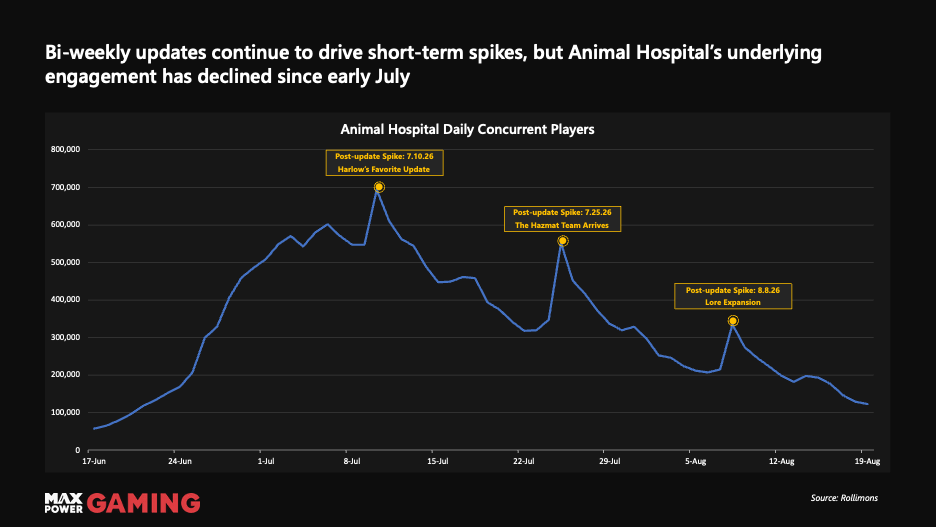
But Animal Hospital is not alone. Two of Roblox’s other major summer breakouts highlighted in our article on July's top games, Grow a Garden 2 and +1 Speed Keyboard Escape, are also showing signs of cooling. Grow a Garden 2 has fallen from an average of roughly 463K concurrent players in July to 336K in August-to-date, a decline of about 27%. +1 Speed Keyboard Escape has dropped from approximately 354K to 237K over the same period, down roughly 33%. That monthly average also understates Grow a Garden 2’s most recent slowdown, with its daily player count declining sharply during the second half of August.
Game | July avg. CCU | Aug. to date | Change |
Animal Hospital | 471K | 214K | -55% |
Grow a Garden 2 | 463K | 336K | -27% |
+1 Speed Keyboard Escape | 354K | 237K | -33% |

Cooling is not unique to Animal Hospital, but the magnitude of its decline stands out. Its August-to-date average has fallen more than twice as quickly as Grow a Garden 2’s and substantially faster than +1 Speed Keyboard Escape’s.
These declines illustrate how quickly audience attention can shift on Roblox. Reaching the top of the platform is one challenge; maintaining that audience after the initial novelty fades is another.
Animal Hospital has already proven it can create a breakout. The harder challenge is continuing to give players new reasons to return once the novelty begins to wear off.
Want more Roblox insights like this?
Join 3K+ subscribers to our weekly Roblox newsletter,
read by business leaders at Roblox, Epic Games, EA, Xbox, and Disney.


Comments