

Escape Tsunami for Brainrots: Roblox’s Next Brainrot Juggernaut

Join 2.5K+ business leaders (at Roblox, Epic Games, Xbox) subscribed to the #1 Roblox newsletter: sign up here
By Ken Bryan
The Brainrot Era Continues
If you were hoping brainrot games would stay firmly in 2025, bad news: Roblox kicked off 2026 with another viral brainrot game, and this one is already topping the charts.
Escape Tsunami for Brainrots has rapidly become one of the most popular games on the platform. The numbers tell the full story. According to Rollimon’s data, the game has recorded the fifth-highest peak concurrent users of any Roblox game ever, flirting with nearly 5 million CCUs at its peak.

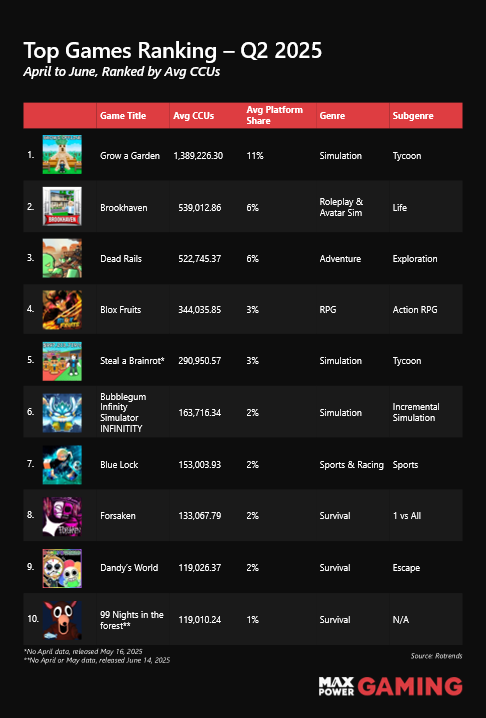
It is currently the top brainrot game on Roblox and one of the most played games on the platform in January, overtaking Steal a Brainrot, the title that defined the genre’s explosive rise last year and still holds the record for the highest peak CCU in Roblox history. What makes this ever more interesting is that both games are owned by Do Big Studios, one of the largest Roblox-focused game studios, also behind recent hits like Fisch and Grow a Garden.

At its core, Escape Tsunami for Brainrots is best described as a mash-up of Steal a Brainrot and Be Crushed by a Speeding Wall, an old-school Roblox survival experience that first found popularity back in 2008, then later recreated in 2016, where it truly took off and cemented its place as a platform classic. Much like Plants vs Brainrots, which found success by combining Plants vs Zombies with Steal a Brainrot, Escape Tsunami follows the same formula: taking a proven Brainrot framework and layering in a second, more active gameplay hook to dramatically increase engagement and refresh the Brainrot genre. Other recent examples include My Fishing Brainrots, which combines the Brainrot formula with fishing mechanics.
Gameplay: Simple Fast, and Constantly Punishing

Collect Brainrots —> Survive Tsunamis —> Upgrade —> Repeat
That loop is doing far more than it appears on the surface.
Like Steal a Brainrot, players collect Brainrots and display them at their base, where they generate passive income over time. Showing off rare Brainrots to other players remains a core motivator. Where Escape Tsunami meaningfully differentiates itself is how those Brainrots are collected.
Instead of waiting for items to appear, players must actively run through a long, narrow map to gather brainrots before tsunami waves sweep across it. If a wave hits you, the run ends immediately, and you respawn back at the start.
The map is divided into progression zones, with brainrots becoming more valuable the farther players reach. Early zones are forgiving, but deeper zones introduce tighter escape windows and far less margin for error. Every step forward increases both potential reward and the risk of losing the run.
To survive, players must reach small safe pockets or gaps in the environment just before the tsunami arrives. These safe zones become harder to reach the farther out players go, forcing constant judgment calls: turn back early with a guaranteed escape, or push deeper in hopes of finding rarer brainrots.
Upgrades are what make this increased risk manageable:
Speed determines how quickly players can run and helps progress through zones
Carry capacity limits how many brainrots can be brought back per run
Base expansion increases brainrot storage and boosts long-term passive income
Brainrot upgrades increase how much money each brainrot earns over time
Rebirths reset Speed back to zero in exchange for permanent money multipliers
Together, these systems function as a hard progression gate. Without investing in upgrades, players simply cannot reach or escape higher-tier zones consistently.
Beyond efficiency, upgrades and rebirths also allow players to push deep enough into the map to hunt for the game’s rarest Brainrots, the primary long-term goal for many players. Each upgrade slightly widens what’s possible on the next run, encouraging players to re-enter the loop again and again in pursuit of increasingly rare Brainrots to collect and flex.
The Drivers Behind Escape Tsunami’s Rise

In many ways, Escape Tsunami for Brainrots is simply Steal a Brainrot with more engaging and entertaining gameplay layered on top. The same core drivers that made Steal a Brainrot go viral are all present here, they’re just paired with a more active and higher-stakes gameplay loop.
At its foundation, collecting Brainrots and showing them off to other players remains the primary motivator. Rare Brainrots function as status symbols, and flexing is still the point. Players want to own the rarest Brainrots in the game and make that ownership visible to everyone else in the server.
On top of that, Escape Tsunami adds systems that amplify engagement and replayability:
Admin Abuse events, limited-time modes, and frequent updates ensure the game never feels static.
Ultra-rare Brainrots extend the endgame by creating long-term aspirational targets
Optional stealing mechanics and pay-to-win shortcuts introduce competition and friction between players.
Leaderboards and progression milestones reward optimization and time investment.
Combined with a more active gameplay loop, these systems create the kind of close calls and chaotic moments that streamers and YouTubers gravitate toward, making the game naturally social and fun to play with friends
The Drivers Behind Escape Tsunami’s Rise

One of the most interesting developments is that Do Big Studios didn’t stop at Roblox. The studio has also launched Escape Tsunami inside Fortnite Creative, where it has quickly become one of the most popular UGC experiences not created by Epic Games, even though Fortnite Creative’s overall audience is significantly smaller than Roblox’s.
Do Big Studios have already proven this strategy works:

This is a major milestone. Until recently, numbers at that scale were almost exclusively reserved for Epic-made experiences. Seeing a Roblox-originated game reach that level of success on Fortnite Creative signals a meaningful shift in how UGC hits can travel across platforms, rather than remaining confined to a single ecosystem.
As more Roblox games continue to find success on Fortnite Creative, it’s becoming increasingly likely that cross-platform UGC launches will become standard practice for top-performing titles like Escape Tsunami. For studios like Do Big, with the resources and infrastructure to support multi-platform releases, Roblox is no longer the ceiling, it’s the launchpad for maximizing reach, revenue, and long-term player engagement.
A Formula That Keeps Winning

At this point, the pattern behind Roblox’s biggest hits is hard to ignore. The games that consistently rise to the top tend to share the same core traits: simple mechanics, extremely low barriers to entry, and backing from increasingly professionalized Roblox studios that acquire promising titles and use their resources to scale them rapidly.
Escape Tsunami for Brainrots is one of the clearest examples of this formula in action. By combining a familiar Brainrot collection framework with a more engaging survival loop, the game has become not only the top Brainrot title, but the third most-played Roblox game in January by average CCU. When zooming in on the final two weeks of January, Escape Tsunami emerges as the most played game on the platform.

Its success has even begun to reshape its closest competition. In response to Escape Tsunami’s rise, Steal a Brainrot introduced an Escape Tsunami LTM of its own, a near-direct replication of the core loop, creating the unusual situation where two competing games with the same ownership are effectively chasing each other using the same mechanics.
At the same time, there are clear signs of fatigue within the Roblox community. Reddit Threads (Thread 1, Thread 2) regularly surface frustration around brainrot games dominating the charts, with players expressing concern that simpler, highly optimized games are crowding out more creatively ambitious games. That tension is real, but history suggests it has little impact on what ultimately succeeds.
Based on current trends, and how 2025 played out, Brainrot games aren’t a passing phase. They’re a structural part of Roblox’s ecosystem now. And if Escape Tsunami for Brainrots is any indication, they’re not slowing down anytime soon.

Want more Roblox insights like this?
Join 2.5K+ subscribers to our weekly Roblox newsletter,
read by business leaders at Roblox, Epic Games, Xbox, and Disney.


Comments